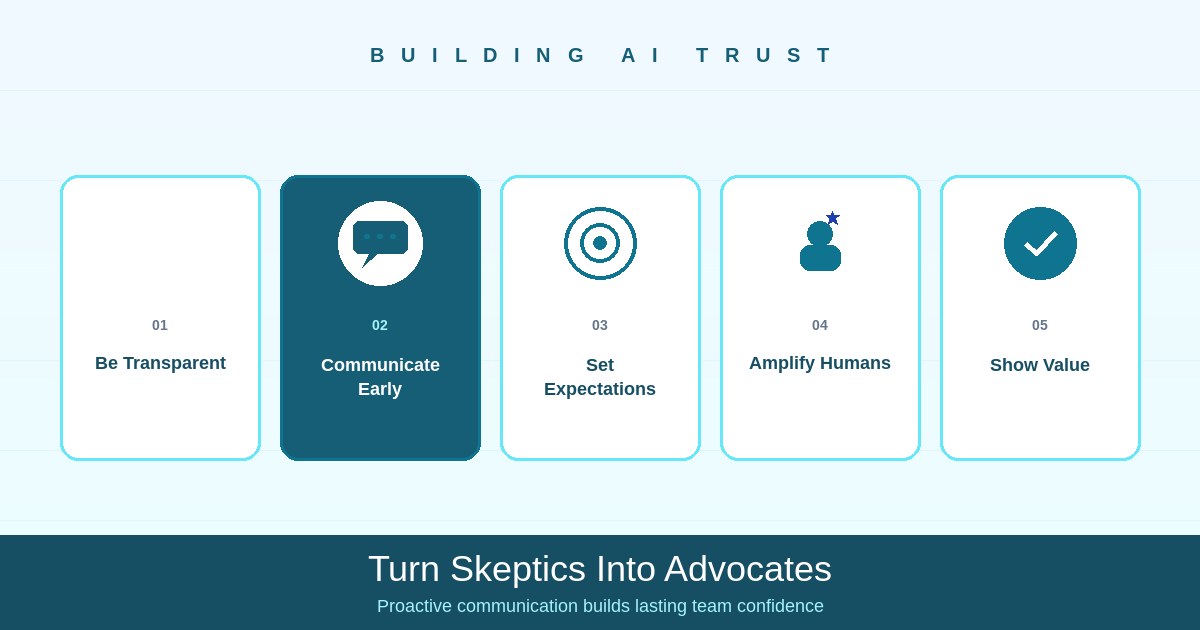
Building trust in AI isn’t just about showcasing impressive demos or citing industry statistics. It’s about addressing the very human concerns that arise when new technology enters established workflows. The teams that succeed with AI adoption spend as much time on trust-building as they do on technical implementation.
How do you build trust in AI with your team?
Start with transparent communication about what AI will and won’t do specifically in your context. Explain human oversight mechanisms clearly so people understand their continued role. Address job displacement fears directly with honest conversations about role evolution, not evasive optimism.
Trust emerges when people understand exactly what AI will do, what it won’t do, and how it fits into their daily work. This clarity eliminates the uncertainty that breeds resistance and creates space for genuine partnership between humans and AI systems. It’s a cornerstone of any effective AI adoption playbook.
Why Trust Issues Emerge Before AI Even Arrives
Resistance to AI rarely stems from the technology itself. It comes from uncertainty about change and fear of the unknown.
Employees hear conflicting messages about AI everywhere. Media headlines alternate between “AI will eliminate millions of jobs” and “AI will create unprecedented opportunities.” This noise creates anxiety that follows people into the workplace.
When leadership announces an AI initiative without context, teams fill information gaps with assumptions. They wonder: Will this replace me? Will I understand how to use it? What happens if I can’t adapt?
These concerns are rational and predictable. Acknowledging them upfront prevents them from becoming roadblocks later.
The Foundation: Clear Communication About AI’s Role
Trust starts with honest communication about what AI actually does in your specific context. Skip the industry hype and focus on practical realities.
Explain the specific tasks AI will handle and which decisions remain with humans. For example: “The AI agent will draft initial client responses based on our guidelines. You’ll review, edit, and approve every message before it goes out.”
Be Specific About Human Oversight
Teams need to understand their continued role in the process. Detail how human judgment remains central to outcomes.
Describe the partnership model clearly. AI handles routine analysis, humans make strategic decisions. AI processes data quickly, humans interpret what it means for specific clients or situations.
This specificity helps people visualize their enhanced role rather than worrying about displacement.
Address the “Black Box” Concern
Many people distrust AI because they don’t understand how it reaches conclusions. You don’t need to explain algorithms, but you should clarify how decisions get made.
For custom AI agents, explain the logic: “The agent recommends priority levels based on client tier, issue type, and response timeframes we’ve defined together.” For off-the-shelf tools, describe how you’ll validate outputs.
Creating Early Wins That Build Confidence
Small, visible successes create trust faster than lengthy explanations. Design initial AI implementations to deliver clear value without disrupting core workflows.
Start with tasks that people find tedious or time-consuming. When AI handles data entry, research, or initial drafts, teams immediately see the benefit of amplified capacity rather than feeling threatened.
Choose early use cases where success is easy to measure and hard to dispute. Time saved, errors reduced, or consistency improved — these concrete outcomes build credibility for larger AI initiatives.
Show, Don’t Just Tell
Demos matter, but working sessions matter more. Let team members interact with AI tools in low-stakes environments before full implementation.
Walk through real scenarios together. Show how AI suggestions get reviewed and refined. Demonstrate the feedback loops that improve AI performance over time.
This hands-on experience builds familiarity and reduces the mystery factor that breeds distrust.
How do you address team resistance to AI?
Proactive trust-building prevents resistance from hardening into organizational skepticism. Address job displacement fears directly and honestly through conversations about real role evolution, routine tasks shift to AI while human expertise becomes increasingly valuable for judgment and strategy. Show concrete examples of how people’s roles are enhanced, not diminished.
Be honest about how roles will evolve. Some tasks will shift to AI, but human expertise becomes more valuable, not less. People move from executing routine work to making strategic decisions with better information.
Explain the business case clearly: AI helps the organization grow and compete, creating opportunities for human expertise to have greater impact.
Reframe from Replacement to Partnership
Use language that reinforces augmentation over automation. Instead of “AI will handle customer inquiries,” say “AI will help you respond to customer inquiries faster and more consistently.”
This isn’t just semantics. The framing shapes how people understand their relationship with AI tools and their continued value to the organization.
Share examples from other companies where AI adoption led to role enhancement rather than elimination. Make the partnership model tangible and believable.
Why does team resistance to AI matter more than the technology itself?
Resistance signals deeper organizational issues, lack of trust, poor change management, or misaligned incentives. Technology only succeeds when people adopt it, and people resist change they don’t understand or believe in. Unaddressed resistance creates passive sabotage: minimal usage, poor inputs, negative sentiment that spreads. The cause sits upstream of the tool itself.
Transparency about limitations builds more trust than overselling capabilities. Acknowledge what AI can’t do and how the organization will handle those gaps.
Discuss failure modes openly. What happens when AI makes mistakes? How will the team identify and correct errors? Who maintains accountability for final outcomes?
This honesty demonstrates that leadership understands AI’s boundaries and has thoughtful plans for human oversight.
Involve Teams in AI Decision-Making
Trust grows when people feel heard in the process. Include team members in selecting AI tools and defining implementation approaches.
Ask for input on workflow integration. Which tasks would benefit most from AI assistance? What concerns should guide the rollout timeline? How should success be measured?
This involvement creates ownership and investment in AI success rather than passive resistance to imposed change.
Measuring and Maintaining Trust Over Time
Trust in AI isn’t built once — it requires ongoing maintenance through consistent performance and clear communication.
Regularly check in with teams about their AI experience. What’s working well? Where are pain points emerging? How can the partnership between humans and AI improve?
Celebrate successes and address problems quickly. When AI delivers value, make sure people recognize how their expertise made it possible. When issues arise, fix them transparently and explain the improvements.
Creating Feedback Loops
Establish clear channels for ongoing input about AI performance. Teams should feel comfortable reporting when AI suggestions seem off or when they need additional context.
Use this feedback to continuously improve AI performance and demonstrate that human judgment remains central to the system’s evolution.
Building trust in AI is really about building trust in the organization’s approach to change. When teams see thoughtful planning, honest communication, and genuine partnership, they become advocates for AI adoption rather than obstacles to overcome. The technology succeeds because the people strategy succeeds first.
Related reading: