Your team needs AI training, but the last thing you want is to create more anxiety in an already uncertain time. The key isn’t cramming everyone into a conference room for death-by-PowerPoint sessions about machine learning algorithms.
How do you train your team on AI without overwhelming them?
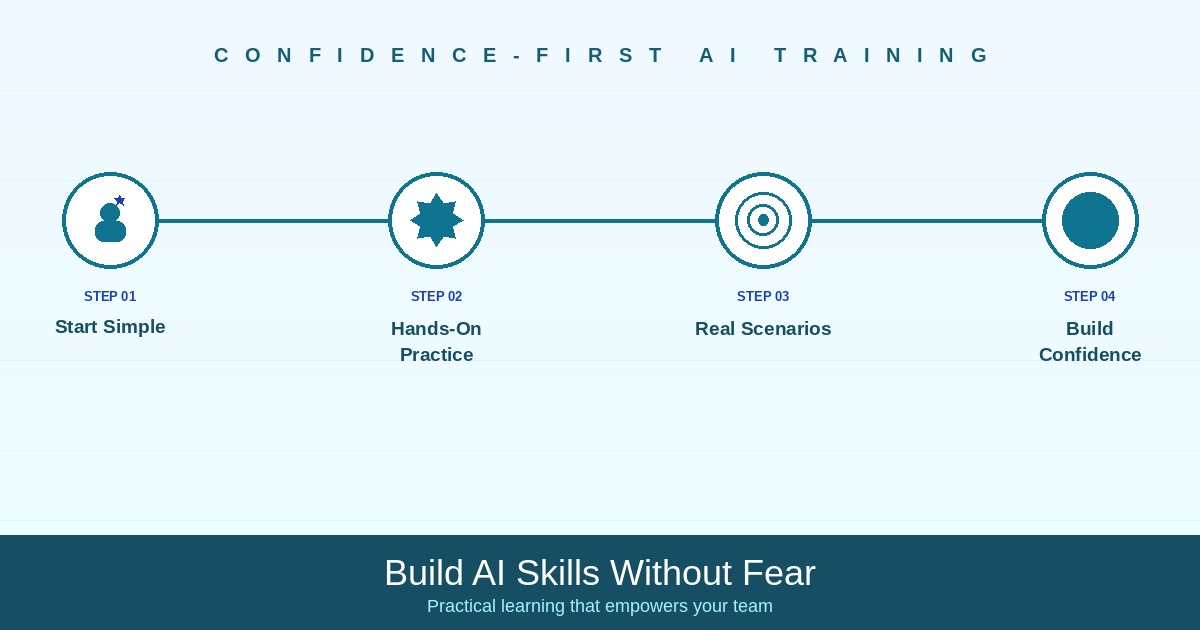
Start by addressing job security and role evolution concerns before teaching capabilities, people can’t focus on learning while worried. Use real work scenarios, not theoretical examples, showing how AI handles specific daily tasks. Structure training around four weeks with simple tasks week one, workflow integration week two, complex scenarios week three, independent practice week four.
Effective AI training builds confidence through hands-on practice with real work scenarios. It starts with addressing concerns, focuses on augmenting existing skills, and gives people control over their learning pace. Done right, training becomes the foundation for sustained AI adoption across your organization. This is core to our AI Literacy & Training program.
Why Most AI Training Programs Miss the Mark
Most AI training fails because it focuses on the technology instead of the people using it.
Traditional approaches dump technical concepts on employees who just want to know how this affects their daily work. They explain neural networks to accountants who need to understand how AI can help with expense reporting. They showcase cutting-edge capabilities without addressing the elephant in the room: job security concerns.
This backwards approach creates more resistance, not less.
People don’t need to understand how AI works — they need to understand how it works for them. Your finance team doesn’t need a computer science degree. They need to see how AI can eliminate the tedious parts of their job so they can focus on strategic analysis.
The most successful AI training programs we’ve seen start with empathy, not algorithms.
What’s the right pace for AI training?
The most effective AI training programs run 2 to 4 weeks with short, focused daily sessions that allow people time to practice what they learned between lessons. Programs that stretch longer lose momentum, bore participants, and create fatigue that undermines actual learning. Intensity and spacing matter more than total duration.
Before diving into what AI can do, address what your team is worried about.
Create space for honest conversations about job security, skill relevance, and role changes. Don’t dismiss these concerns or rush past them with generic reassurances. Acknowledge that AI will change how work gets done — and explain specifically how you see people’s roles evolving.
This isn’t touchy-feely stuff. It’s practical change management. People can’t focus on learning when they’re worried about their future.
Use real examples from your industry. Show how similar companies have integrated AI while maintaining or growing their workforce. Be specific about which tasks might shift to AI and which human skills become more valuable.
The “What’s In It For Me” Framework
Structure these early conversations around three questions every employee is asking:
- What parts of my job will AI handle?
- What parts will remain uniquely human?
- How will my role become more valuable?
Answer these questions honestly for each role or department. Marketing might learn that AI handles initial content drafts while humans focus on strategy and brand voice. Sales teams might discover AI can qualify leads while they build deeper client relationships.
The goal is clarity, not false comfort. People can handle change when they understand it.
Design Training Around Real Work Scenarios
Once you’ve addressed concerns, shift to hands-on learning with actual work tasks.
Forget theoretical examples. Use real projects, real data, and real problems your team faces every day. If you’re training customer service reps, practice with actual customer inquiries. If you’re working with analysts, use genuine datasets from your business.
This approach serves two purposes: it makes learning immediately relevant, and it demonstrates AI’s value in familiar contexts.
Start with simple, low-stakes tasks where AI can provide obvious value. Let people experience quick wins before tackling more complex applications.
The Progressive Complexity Model
Week 1: Basic familiarization with simple, single-task applications Week 2: Integration with existing workflows and tools Week 3: More complex scenarios requiring judgment and human oversight Week 4: Independent practice and troubleshooting
This progression builds confidence naturally. People gain comfort with AI’s capabilities while reinforcing their own expertise and judgment.
Each week should include both guided practice and independent exploration time. Create safe spaces where people can experiment without fear of breaking anything or looking foolish.
Make It Role-Specific, Not One-Size-Fits-All
Your accounting team and your creative team need completely different AI training.
Generic training programs waste time and miss opportunities to show real value. Role-specific training demonstrates how AI amplifies the skills people already have rather than replacing them with generic capabilities.
Accountants learn how AI can handle data entry and basic analysis while they focus on interpretation and strategic recommendations. Designers discover how AI can generate initial concepts while they refine, critique, and ensure brand alignment.
Customize by Function, Not Just Department
Go deeper than departmental divisions. A senior analyst and a junior analyst in the same department need different training approaches.
Senior professionals often benefit from strategic overviews and integration planning. They need to understand how AI fits into broader business objectives and team management.
Junior team members typically want tactical, hands-on training. They’re eager to learn tools that can accelerate their daily work and help them contribute more effectively.
Mid-level employees often need both perspectives — tactical skills for immediate application and strategic understanding for team leadership.
Tailor your training content and pace to match these different needs and experience levels.
Build Confidence Through Guided Practice
Confidence comes from successful repetition, not perfect understanding.
Structure training sessions so people experience multiple small wins rather than struggling through complex scenarios. Start with AI applications that clearly improve on manual processes — tasks that are obviously faster, more accurate, or less tedious with AI assistance.
Document these wins. When someone successfully uses AI to complete a task that previously took hours, capture that moment. Share these stories across the team to build momentum and reduce skepticism.
Create Learning Partnerships
Pair people with different comfort levels around technology. This isn’t about “tech-savvy” versus “non-tech-savvy” — it’s about creating mutual support systems.
Someone comfortable with new software can help a colleague navigate AI interfaces. Someone with deep domain expertise can help others interpret AI outputs and apply professional judgment.
These partnerships often become the foundation for long-term AI adoption. People continue learning from each other long after formal training ends.
Measure Understanding, Not Just Completion
Tracking training completion rates tells you nothing about actual learning or adoption.
Focus on practical demonstrations of understanding. Can people explain when to use AI and when not to? Can they identify situations where human judgment is essential? Do they know how to evaluate AI outputs for accuracy and relevance?
These skills matter more than technical proficiency. Someone who understands AI’s limitations and applies appropriate oversight will get better outcomes than someone who can operate the tools but lacks judgment.
Use Real Scenarios for Assessment
Skip the multiple-choice quizzes. Instead, present realistic work scenarios and ask people to walk through their approach.
“Here’s a customer inquiry that seems perfect for our AI assistant. How would you handle it?”
“This AI analysis looks impressive, but something feels off. What would you check?”
“A client is asking for deliverables that AI could help with. How would you structure this project?”
These scenario-based assessments reveal genuine understanding and build confidence in applying judgment alongside AI tools.
What should AI training cover for non-technical teams?
Start with role-specific context, not technical theory. Teach practical skills: how to evaluate AI outputs, recognize when AI is wrong, write effective inputs, and maintain professional standards. Anchor on the team’s actual daily tasks, not abstract concepts. Cover limitations alongside capabilities. Structure by experience level, senior staff need strategic context, junior staff need tactical hands-on practice.
Training doesn’t end when the formal program finishes.
AI capabilities evolve rapidly, and people’s comfort levels develop at different paces. Plan for ongoing support that matches how people actually learn and adopt new tools — gradually, with lots of questions and occasional setbacks.
Establish regular check-ins, peer mentoring systems, and channels for getting help with specific challenges. Create space for people to share discoveries and learn from each other’s experiments.
The most successful organizations treat AI training as an ongoing capability development process, not a one-time event. They build cultures where continuous learning and adaptation become natural parts of how work gets done.
Your team is ready to learn. They just need training that respects their intelligence, addresses their concerns, and shows them how AI can make their work more meaningful — not more precarious. Start there, and everything else becomes much easier.
Related reading: