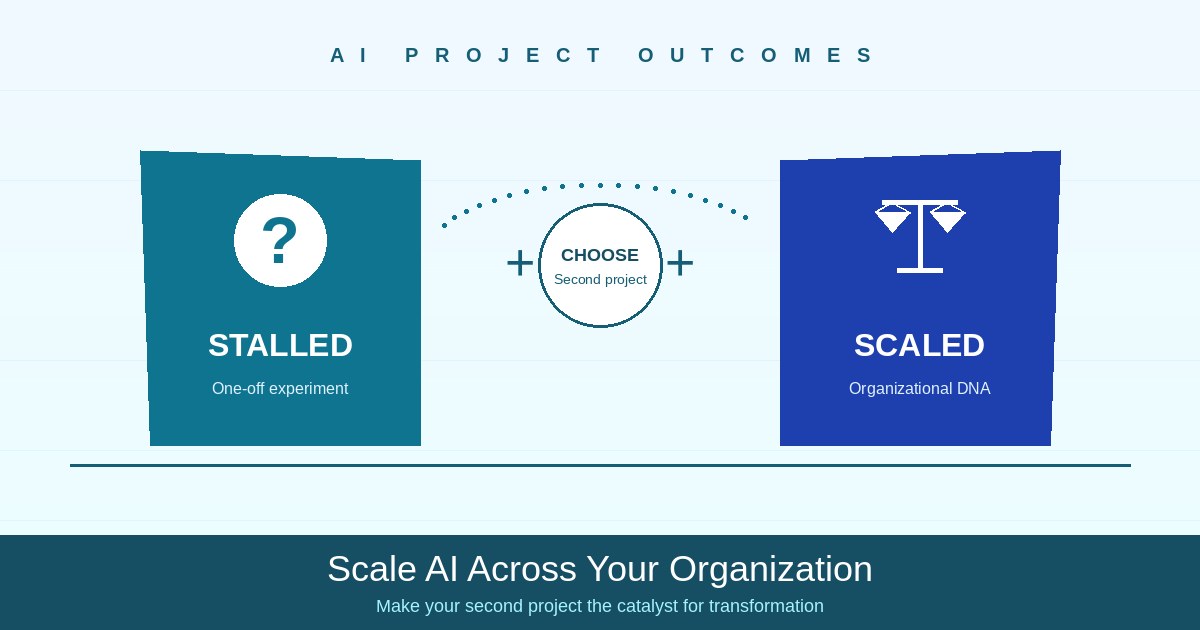
Your first AI project was about proving the concept. Your second AI project is about proving the strategy. While most organizations celebrate their initial AI success and then wonder why momentum stalls, the truth is simpler: how you approach your second AI implementation determines whether AI becomes part of your organizational DNA or remains a one-off experiment.
Why does your second AI project matter more than your first?
Your second project determines whether AI adoption becomes lasting organizational momentum or remains just an isolated, one-off experiment. While first projects focus on proof-of-concept with ideal conditions, second projects test whether your proven methodology actually works across different contexts, teams, and workflows. Success here proves you can replicate outcomes reliably.
This decision sits at the heart of your broader enterprise AI strategy. The second project carries the weight of expectation, the lessons of experience, and the opportunity to either build lasting organizational capabilities or confirm that AI is “just another tech initiative.” Getting it right requires different thinking than your pilot project.
How do you choose your second AI project?
Choose projects that build on what you learned while demonstrating 15–20% more ambition than your first. If your first agent handled routine inquiries, now augment complex decision-making where judgment matters more. Partner with departments that observed your first success firsthand but weren’t directly involved—they bring energy without implementation fatigue.
Your second AI project selection shouldn’t follow the same criteria as your first. Where your pilot prioritized low risk and quick wins, your follow-up needs to balance ambition with organizational learning.
Look for projects that amplify what you learned from round one. If your first agent automated routine inquiries, consider one that augments complex decision-making. If you started in customer service, explore how similar principles might apply to internal operations.
The sweet spot is 15-20% more ambitious than your first project. Enough stretch to demonstrate growth in your AI capabilities, but not so much that you lose the focused execution that made your pilot successful.
Building on Existing Relationships
Your first project created a network of AI believers, skeptics-turned-supporters, and people who understand what working with AI actually feels like day-to-day. These relationships are invaluable for your second project.
Partner with departments that witnessed your first success but weren’t directly involved. They’ve seen the outcomes without experiencing implementation fatigue. Their fresh energy combined with your team’s growing expertise creates ideal conditions for expansion.
What’s the difference between a one-off AI win and AI momentum?
One-off wins create isolated results; momentum builds repeatable capability. Single projects deliver local outcomes. Momentum happens when teams start identifying AI opportunities themselves, when lessons transfer across departments, and when partnership becomes embedded in how people work. Building it requires treating each project as methodology validation and developing champions who carry the value forward.
Most teams overestimate how much their first project taught them about AI in general, and underestimate how much it taught them about change management, stakeholder communication, and the human side of augmentation.
The Knowledge Gaps That Matter
Your team now knows how AI works in one specific context. Your second project needs to test whether that knowledge transfers. Different departments have different workflows, communication styles, and success metrics.
The goal isn’t to replicate your first project elsewhere. It’s to apply the partnership mindset you developed to a new challenge. This builds organizational capability rather than just expanding AI usage.
How to Avoid the “Sophomore Slump” in AI Implementation
Many organizations stumble on their second AI project because they assume it will be easier than the first. The opposite is often true. Your second project carries higher expectations, faces more scrutiny, and can’t rely on novelty to maintain engagement.
Avoid the common trap of going too big too fast. Your success with one agent doesn’t mean you’re ready for five agents across three departments. That path leads to scattered attention, diluted support, and confused priorities.
Instead, think of your second project as validating your AI methodology rather than just implementing another tool. Focus on replicating the process that made your first project successful, adapted for new circumstances.
Managing Elevated Expectations
Your stakeholders now have higher expectations. They’ve seen what AI can do and want to see it do more. This pressure can push you toward overly complex projects that sacrifice execution quality for scope.
Set clear boundaries early. Explain that each project builds organizational capability for the next one. Your second project’s job is to prove that your first wasn’t a fluke — that you can repeatedly deliver AI implementations that augment human expertise effectively. This is why understanding the hidden costs of AI implementation matters; budgeting pressure often intensifies when your organization is evaluating the second project.
Building Organizational AI Momentum That Sustains
True AI adoption happens when teams start identifying opportunities themselves rather than waiting for top-down initiatives. Your second project should create conditions for this organic growth.
Document and share your decision-making process openly. Let other departments see how you evaluated opportunities, planned implementation, and measured success. This transparency helps them imagine AI applications in their own work.
Create opportunities for cross-pollination. Have team members from your first project participate in planning or training for the second. Their firsthand experience with AI partnership becomes organizational knowledge.
Creating AI Champions, Not Just AI Users
Your second project should develop people who can articulate the value of human-AI partnership to others. These champions understand both the capabilities and limitations of AI, and can speak credibly about the experience of working alongside AI agents.
Identify team members who are natural teachers and communicators. Give them prominent roles in your second project and explicit responsibility for sharing lessons learned. Their voices will carry more weight than any executive mandate.
When to Pivot Your AI Strategy Based on Early Results
Your second project is also your first real test of whether your overall AI strategy makes sense. If you’re struggling to find a good follow-up project, or if your second implementation feels forced, it might be time to step back and reassess.
Strong AI strategies generate obvious next steps. If your path forward isn’t clear, you may need to adjust your approach rather than your timeline.
Sometimes the right second project is in a completely different area than your first. If your pilot revealed unexpected organizational needs or capabilities, following those insights might serve you better than staying within your original plan.
Signs Your Strategy Needs Adjustment
If stakeholders are asking “what’s next?” instead of suggesting their own ideas, your first project may not have demonstrated AI’s potential clearly enough. If multiple departments are competing for your attention, you might need better criteria for prioritization.
The goal is sustainable momentum. If your second project feels like you’re pushing a boulder uphill instead of channeling existing energy, pause and understand why.
Your second AI project sets the pattern for everything that follows. Approach it with the same thoughtful planning that made your first project successful, but with the confidence that comes from proven experience. The organizations that get their second project right don’t just implement AI — they become places where human expertise and artificial intelligence work together naturally, creating outcomes neither could achieve alone.
Related reading: